Reactors
canterax.ReactorNet advances constant-pressure adiabatic reactor trajectories using JAX-based ODE solvers.
Model scope
The current reactor path is:
zero-dimensional
constant pressure
adiabatic
The state vector is arranged as:
[T, Y_0, Y_1, ..., Y_{n-1}]
Basic usage
import cantera as ct
import jax.numpy as jnp

from canterax import ReactorNet, Solution

gas = Solution("gri30.yaml")
gas.TPX = 1200.0, ct.one_atm, "H2:2.0, O2:1.0, N2:3.76"

net = ReactorNet(gas.mech)
sol = net.advance(
    T0=gas.T,
    P=gas.P,
    Y0=jnp.array(gas.Y),
    t_end=1e-3,
)
Solver choices
By default, advance(...) uses Diffrax Kvaerno5, which is a stiff implicit Runge-Kutta method.
You can also request the experimental custom BDF path:
sol = net.advance(
    T0=gas.T,
    P=gas.P,
    Y0=jnp.array(gas.Y),
    t_end=1e-3,
    solver="bdf",
)
Output shape
Default Diffrax path:
sol.tscontains saved timessol.yscontains saved statessol.ys[:, 0]is temperaturesol.ys[:, 1:]are species mass fractions
Experimental BDF path:
returns a dictionary-like structure with
ts,ys, andstatsstatsincludes step and function-evaluation counters
Saving trajectories
Use Diffrax SaveAt if you want samples at prescribed times.
import diffrax
import jax.numpy as jnp

ts = jnp.linspace(0.0, 1e-3, 200)
saveat = diffrax.SaveAt(ts=ts)
sol = net.advance(
    T0=gas.T,
    P=gas.P,
    Y0=jnp.array(gas.Y),
    t_end=1e-3,
    saveat=saveat,
)
Practical notes
Y0should be a JAX array if you are staying in a JAX-native workflow.The reactor implementation is designed for differentiable simulation, but the current docs focus on forward simulation behavior.
The BDF path is marked experimental and has more limited differentiation support than the default Diffrax solver.
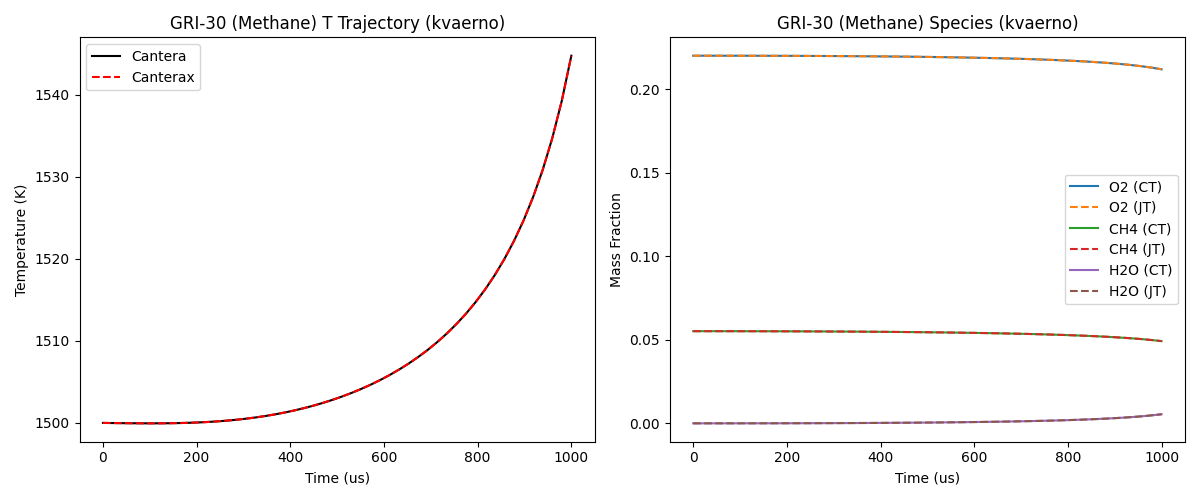
Validation image
The repository includes parity plots comparing Canterax and Cantera reactor trajectories.